The First Mechanical pencil...

Wednesday, November 26, 2008

The mechanical pencil was invented in 1915 by Tokuji Hayakawa (November 3, 1894-June 24, 1980). His first mechanical pencil was called the "Ever-Ready Sharp Pencil." Hayakawa had owned a metalworking shop in Tokyo, Japan, and in 1942, expanded his company and renamed it the Hayakawa Electric Industry Co.,Ltd. It was later called the Sharp Corporation (1970), and Hayakawa was appointed chairman.

The First Leak-proof fountain pen...

Friday, November 21, 2008

Lewis E. Waterman was an American inventor and insurance salesman who developed a relatively leak-proof fountain pen; he patented his new invention in 1884 and revolutionized writing. Before his fountain pen, pen tips had to be tipped into ink after every few words. Waterman put an ink reservoir in the pen above the pen's metal nib (point). This reservoir would hold enough ink for a few pages of writing. There were many problems in developing the fountain pen, especially the difficulty of controlling the flow of the ink. Putting a sealed reservoir above the nib wouldn't let the ink flow, but if it wasn't sealed, all the ink would flow at once. Waterman used capillary action to replace the ink in the rubber sac with air so that the ink flowed smoothly but did not flow all at once. Also, the metals in the ink dissolved the steel pen nib, so Waterman used an iridium-plated gold nib. Waterman was also the first person to place a clip on the cap of the pen.

The First Gas mask...

Sunday, November 16, 2008

Garrett Augustus Morgan (March 4, 1877 - August 27, 1963) was an African-American inventor and businessman. He was the first person to patent a traffic signal. He also developed the gas mask (and many other inventions). Morgan used his gas mask (patent No. 1,090,936, 1914) to rescue miners who were trapped underground in a noxious mine. Soon after, Morgan was asked to produce gas masks for the US Army.

The First Electric iron...

Tuesday, November 11, 2008

The electric iron was invented in 1882 by Henry W. Seeley, a New York inventor Seeley patented his "electric flatiron" on June 6, 1882 (patent no. 259,054). His iron weighed almost 15 pounds and took a long time to warm up.
Other electric irons had also been invented, including one from France (1882), but it used a carbon arc to heat the iron, a method which was dangerous.

The First Dishwasher...

Thursday, November 6, 2008

The first dishwasher was patented in 1850 by Joel Houghton; his machine was a hand-turned wheel that splashed water on dishes - unfortunately, it wasn't very effective at washing dishes. The first working automatic dishwasher was invented by Mrs. Josephine Garis (W. A.) Cochran, of Shelbyville, Illinois, in 1889. Her dishwasher was a wooden tub with a wire basket in it - the dishes went in the basket, and rollers rotated the dishes. As a handle on the tub was turned, hot, soapy water was sprayed into the tub, cleaning the dishes. Cochran's machine was first shown at the 1893 World's Fair in Chicago, Illinois. At first, her machine was only bought by some restaurants and hotels. Cochran's small company was eventually associated with the Kitchen Aid Company. The dishwasher didn't become widespread as a labor-saving machine until the 1960s.

The First Can and Can opener...

Saturday, November 1, 2008

A metal can (or canister) for preserving food was invented in 1810 by a Peter Durand, of London, England. Metal cans (also called tins) could preserve food for a long period of time. To open a can, a person had to use a hammer and chisel; the can opener wasn't invented for another 50 years.
The can opener was invented in 1858 by Ezra Warner of Waterbury, Connecticut, USA. Warner's device used a lever and chisel. Until then, cans were opened using a hammer and chisel; the can opener was invented 50 years after the metal can was invented.
The can opener was improved in 1870 by William Lyman of West Meridian, Connecticut, USA. Lyman's device used a rotating wheel and a sharp edge. His can opener only fit one size of can, and first had to pierce the center of the can.
The modern-day type of can opener (using a serrated wheel) was invented in 1925.

The First Cellophane...

Sunday, October 26, 2008

Cellophane is a thin, transparent, waterproof, protective film that is used in many types of packaging. It was invented in 1908 by Jacques Edwin Brandenberger, a Swiss chemist. He had originally intended cellophane to be bonded onto fabric to make a waterproof textile, but the new cloth was brittle and not useful. Cellophane proved very useful all alone as a packaging material. Chemists at the Dupont company (who later bought the rights to cellophane) made cellophane waterproof in 1927.

The First Bar codes...

Tuesday, October 21, 2008

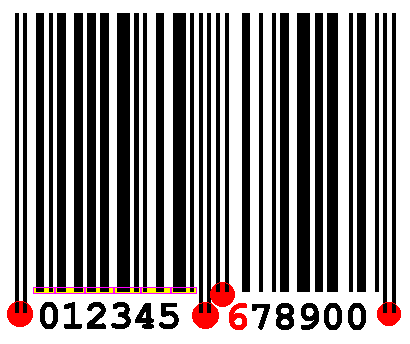
Bar codes (also called Universal Product Codes or UPC's) are small, coded labels that contain information about the item they are attached to; the information is contained in a numerical code, usually containing 12 digits. UPC's are easily scanned by laser beams. UPC's are used on many things, including most items for sale in stores, library books, inventory items, many packages and pieces of luggage being shipped, railroad cars, etc. The UPC may contain coded information about the item, its manufacturer, place of origin, destination, the owner, or other data. The first "bullseye code" was invented by Norman Joseph Woodland and Bernard Silver, from work which they began in 1948. On October 20, 1949, they patented their bullseye code (a series of concentric circles that were scannable from all directions, using regular light). Woodland and Silver patented a new UPC in October 1952; the UPC was also improved and adapted by David J. Collins in the late 1950's (to track railroad cars). UPC's were first used in grocery stores in the early 1970's.